For chandlers4 min read
Chinese, Russian and Japanese requisitions: reading them line by line
In Chinese "斤" is half a kilo, in Russian "шт." means pieces, in Japanese "本" counts bottles. The most common mistakes when reading multilingual lists, and how to avoid them.
The crews of ships passing through your area or calling at your port come from many countries, and their requisitions are written in many languages. English is the most common, but lists in Chinese, Russian, Japanese, Arabic and many other languages are normal. The format changes too: an Excel export from the ship’s management software, a scanned PDF, a photo taken with a phone or lines typed into the body of an e-mail.
In this article we cover the most common mistakes when reading multilingual lists and how to prevent them.
Units: the most expensive mistake
Misreading a product name is usually noticed; misreading a unit quietly breaks the total of the quote. The table below summarizes units you will often meet in requisitions:
| Language | Written as | Meaning |
|---|---|---|
| English | KGS, PCS, PCK / PKT, CTN, CRT, BTL, TIN, JAR, LTR | Kilogram, piece, pack, carton, crate, bottle, tin, jar, litre |
| Chinese | 公斤, 斤, 克, 升, 个, 包, 箱, 瓶, 袋, 罐 | Kilogram, half a kilo, gram, litre, piece, pack, carton, bottle, bag, can |
| Russian | кг, г, л, шт., уп., кор., бут., бан., пач. | Kilogram, gram, litre, piece, pack, carton, bottle, jar, packet |
| Japanese | kg, 個, 本, 箱, 袋, 缶, ケース | Kilogram, piece, bottle or long item, box, bag, can, case |
Two traps need particular care:
- The Chinese “斤” (jin) is half a kilogram. “大米 20斤” means 10 kg of rice, not 20 kg. It may appear in the same list as “公斤” (kilogram).
- The Japanese “本” counts long items such as bottles, pens or rolls. “醤油 1L × 12本” means twelve bottles of soy sauce.
Packing and quantity on the same line
A single line may carry both quantity and packing: “Eggs 30 pcs/tray × 20”, “大米 25公斤/袋 × 4”, “Молоко 1 л × 12 шт.” Here you need to be clear about the unit you are quoting: 20 trays, or 600 eggs? If it is ambiguous, it is better to flag the line with a note than to guess. The master or the purser will quickly answer a one-line question; a quote with the wrong unit damages trust.
Product names: brand, type and local name
Ships may write the same product in different ways. “Lipton Yellow Label”, “立顿黄牌红茶” and “чай Липтон” are the same tea. Some lists ask for a brand explicitly, others give only the type: “rice long grain” or “长粒大米”. If a brand was requested and you do not have it in stock, it is good practice to state clearly in the quote which product you propose instead.
IMPA codes
Some lists give products with IMPA codes. These codes make matching easier; but not every list includes them, and they are not always written correctly. The safest approach is to check the code together with the product name and size. If you link the codes ships send to products in your own catalog and save them, the same code is recognized directly in the next list.
Matching to your catalog
In the end, every line you read has to be linked to a product in your own catalog. Three rules help here:
- Trust exact matches, not similarity. If the name and size match exactly, the match is certain; if they only look similar, the line should be checked.
- Save your corrections. When you link a line to the right product by hand, that link should be saved as an alias, so the same wording is recognized automatically next time.
- Hold back the uncertain line, not the list. A forty-line quote should not wait because of two uncertain lines.
Two languages in the panel, one in the document
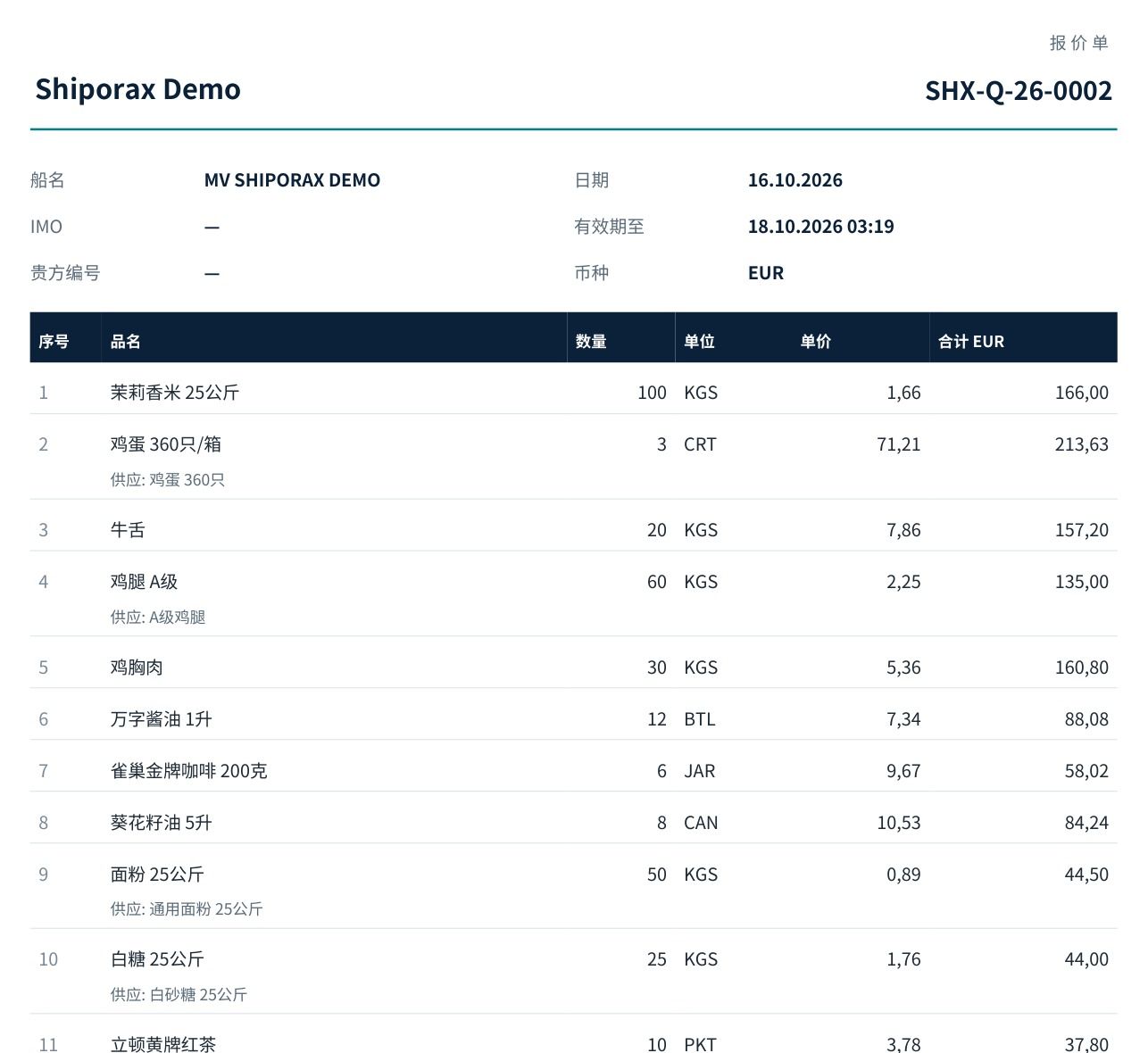
When you work with multilingual lists, there are two different needs. The team preparing the quote wants to read each line in its own language; the ship wants to see the quote in the ship’s language. That is why the Shiporax panel shows each line translated, large, with the original in small type beneath it (in Turkish during the pilot), while the quote document that goes to the ship is prepared in the ship’s language.
Checklist
- Check the unit before the product name, especially 斤, 本 and lines with packing.
- If quantity and packing are on the same line, make the quoted unit clear.
- If a brand was requested, quote it; if not, state the product you propose.
- Verify IMPA codes together with the name and size.
- Save every match you correct by hand.
- Send the quote in the language the list came in.
Frequently asked questions
How do we match lists without IMPA codes?
You match each line to a product in your catalog from its name, size and unit. If you save a match you have confirmed as an alias, the same wording is recognized automatically in the next list.
In which language should we send the quote?
Sending it in the language the list came in speeds up the decision. Document headings and descriptions should be in the ship's language, while product lines keep the wording the ship used.